

12 March 2017
· The real story of the perfumed gloves I gave to Elizabeth ·
When I was a young man, nearly twenty-five and frustrated with my life, I departed England without my wife, to travel on the Continent. It was early February, 1575.
I crossed the Channel and made a beeline to Reims to attend the coronation and wedding of Henri III, near my own age and new to the French throne. I met with his Majesty and his mother, Catherine de’ Medici, imperious in her black widow’s weeds.
I posed for my portrait in Paris, and studied with Sturmius in Strasbourg.
Then to Italy. Based in Venice, I wandered through the patchwork of republics and duchies in the north. The sky was blue, the sun was gold.
In the spring of 1576 after barely more than a year away, I headed home. Had to: liquidity crisis, my funds cut off by my father-in-law. MY funds.
My ship was attacked by Dutch pirates in the Channel. Involuntary research. They took almost everything, but I brought things back inside my head that no freebooter could purloin. My tour was a journey of immersion and absorption. It’s not only in Shake-Speare that you can trace my footsteps, though they’re easy to follow there. It didn’t take long for the court to dub me the Italianate Earl. However they meant it, I took it as a compliment.
I also brought home a new fashion that April. Ephemeral like a spring flower which blossoms with a sweet smell, then fades. But it lasted longer than most fashions or flowers, and I was credited with its creation.
Imagine that. Her Majesty the Queen was a vain woman. It’s hard to blame her much for it, with all the years of insecurity and danger she endured, both before and after she came to her throne. Vanity is a boon when you’re chosen by God and you need to make sure that no one ever forgets it. A modest monarch makes a rotten ruler. (Henry VI. QED.)
High on the list of Bess’s vanities were her two hands with their long, thin fingers. She was always holding things– books, fans, necklaces, gloves, the occasional orb and sceptre. She fidgeted with these props constantly (except the last two), waving them around in front of courtiers and supplicants. Her gestures were stagecraft, commanding the audience’s attention. Her fingers were wiggling bait, luring whatever fish she was angling to catch.

They were lovely hands, but the gimmick was so obvious that her maids would mock her when she wasn’t in the room. Once Nan (Anne Vavasour) was aping the digit-fidgets when Her Majesty returned from a trip to the close stool. The queen slapped Nan so hard across the face, the poor girl had to lay on the vermilion with a trowel for a fortnight to hide the bruise.
 My silly dame, were you worth the
time in the Tower and the limping leg?
Detail, attributed to John de Critz the Elder,
c1605. Collection, Armourers and Brasiers
of the City of London.
In Anne’s portrait her gloves are mismatched, and one’s on, one’s off. You symbolic-meaning sleuths can have some fun with that.Gloves were an important part of the aristocratic kit. Some were worn for warmth and protection, but others were fashion items in their own right. The ones you see in paintings and museums are mostly of the latter type.
 Left, detail, Ditchley portrait,
by Marcus Gheeraerts the Younger, circa 1592
Right, by an unknown painter
(after Gheeraerts) 1590s
 Left, George Clifford, 3rd Earl of Cumberland,
as Queen’s Champion
Miniature by Nicholas Hilliard, circa 1590
Right, detail, the Queen’s glove in his hat as a favour
(National Maritime Museum Greenwich)
Fancy gloves made fancy gifts, and who got more fancy gifts than the Queen? She had piles of them. She kept her own glover and embroiderers busy as well, adding to the piles. She’d give them away occasionally as tokens of her special favour, knowing they’d be cherished as holy relics. Here are the Queen’s gloves, that she gave to me with her own beautiful hands. There were always plenty more back at the Wardrobe.
Almost the only thingThey didn’t bother with my trunkful of books. Their mistake. I saved from the depredations of the Dutch pirates (who took the actual shirt off my back) was my gift for Elizabeth: a pair of perfect, elegant Florentine gloves, trimmed only with a few small roses in raised silk. I’d had her glover write down her hand measurements before I left. The old maestro di guanti who was recommended to me in Florence thought I was having him on. “Nessuna donna ha tali dita!” No woman has fingers like that! I had to pay him extra.
Coals to Newcastle? Nay, by your leave. What made these gloves unique was not just their beauty, but their scent.
The perfuming of gloves was nothing new in the 1570s. It was done to mask the smell of the leather, usually by infusing an interlining with oily, musky ambergris. The best of these gloves came from Spain, but you would not describe them as elegant.
Elizabeth disliked such heavy odours, so I had her new gloves imbued with Acqua della Regina, Water of the Queen. This was a special distillation made by Dominican monks in the farmaceutica at the monastery of Santa Maria Novella in Florence, not far from the maestro’s shop. The scent was light, fresh, and different. In England it would be completely new, and exclusive to Elizabeth. I was certain she would love both the fragrance and the name. Her very own royal perfume.
I simply neglected to tell her that the Regina of the Acqua was not herself, but King Henri’s lady mother, Catherine de’ Medici. Vanity has its uses, and what Bess didn’t know wouldn’t hurt her. Catherine, a native of Florence with popes in her pedigree, had commissioned perfumier Renato Bianco, whom the monks had raised, to create a scent to take to France in 1533 as her bridal gift for Francis I, when at fourteen she was wed to Henri of Valois, Duc d’Orléans, the future Henri II. You could say that Acqua della Regina was the first celebrity fragrance. There is nothing new under the sun.
Of course Bess adored her gift, and the fad took off. Scented Oxford gloves were soon on every smart hand, and whatever was sold as the Earl of Oxford’s perfume flew off the shelves. I never divulged its origin, but I sent my thanks to Catherine, sub rosa, through Ambassador de Castelnau. Back in Reims Catherine had given me a letter to enable my purchase and abet my ruse. (After Francis’s death she wore the scent herself. She smelled so good when we met, I had to ask.) She sent word back that she enjoyed having one up on la reine anglaise des vanités. In Catherine’s Catholic eyes my queen was the bastard daughter of an infamous whore. Élisabeth l’hérétique et usurpatrice. (Catherine had also been Mary Stuart’s first mother-in-law.) My secret was safe with her, and Bess was never the wiser. The knockoff phials sold by the apothecaries smelled nothing like.
Acqua della Regina is an exquisite fragrance, bright with orange blossom and bergamot and whatever else Biancho tossed into the alembic. I smelled it again recently, for the first time in over four centuries. I had to find a chair and a glass of Rhenish, the flood of memories was so overpowering. It’s why I’ve written this down at long last. In Much Ado About Nothing Hero mentions scented gloves given to her by Count Claudio, but that’s as close as I ever came to telling the story. (A count is the same thing as an earl.) Beatrice’s head cold was also an inside joke, but I don’t have to tell you everything.
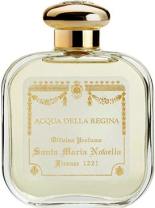 I’ll tell you this: you can buy the Earl of Oxford’s perfume from the very same farmaceutica that I did, with no need for a voucher from the Queen Mother of France. The pharmacy’s doors opened to the public in 1612. Those doors are open today, though Dominicans are no longer involved. Newer doors are also open. Acqua della Regina was for a time called Acqua di Santa Maria Novella, but the non-monks have returned to the older, proper name. It’s still Catherine’s formula. It’s still expensive. It’s still worth it. You’ll have to supply your own gloves.
The flowers of the past still bloom today
’Tis only our attention’s gone astray
- Questions to be answered in Part 2:
- • Do books say anything about this glovely tale?
- • How long were Elizabeth’s fingers, anyway?
- • How did the queen’s gloves escape their fate as pirate booty?
- • What’s up with that post banner?
[ahead to Part 2]
 Sources/Additional Reading for Part 1
This wasn’t intended to be a travelogue of my tour. I’ve skipped a lot. If you want scenic details, read my plays. Or try Richard Roe’s book, which doesn’t mention my name but otherwise serves well. The title could use some work.
- • The Shakepeare Guide to Italy: Retracing the Bard’s Unknown Travels [Google Books]
- · by Richard Paul Roe
- · HarperCollins, 2011
• Margo Anderson’s biography “Shakespeare” By Another Name contains most of my itinerary. Book details can be found on my library page. Anderson makes the connection between my time in Florence, the perfumed gloves, and Santa Maria Novella, though not Catherine de’ Medici, which is understandable.
- • The Road to Polisy [sixdegreesofshakespeare.wordpress.com]
- · by K A Pope
- · July 2016 – February 2018
An intriguing, extremely intelligent exploration into presently unprovable territory. It discusses the Shakespeare plays’ detailed knowledge of the French and Italian connections among noble families and artists during the 16th century, as well as my journey back through France on my return from Italy in early 1576, and what I might have been doing along the way. And a particular painting by Hans Holbein the Younger, and the skull of poor Yorick. And more. There are five parts following the overview. Impressive work. Fair warning: there are charts.
- • Anne Vavasour’s Echo circa 1581 [wikisource.org]
- • Early Modern Women Poets (1520-1700): An Anthology [Google Books]
- · Jane Stevenson, Peter Davidson, editors
- · Oxford University Press, 2001
- · pgs 78-80, entry for Anne Field née Vavasour
- • Santa Maria Novella, Florence’s Most Famous Pharmacy Blooms into its 5th Century [italymagazine.com]
- · by Julie Burns, 11 February 2013
- • Santa Maria Novella, Florence’s 600-year-old perfume store [cnn.com]
- · by Prachi Joshi, 27 March 2015
 VERO NIHIL VERIUS